Nursery Digital Papers: Practical, Print-Ready Resources for Early Learning Design
Creating engaging, developmentally appropriate materials for young children is both rewarding and demanding. Educators, parents, curriculum designers, and small-business owners crafting nursery-themed products often face recurring hurdles: limited design time, inconsistent visual quality, licensing uncertainty, and the need for flexibility across print and digital formats. Nursery Digital Papers offer a focused, high-value solution—curated sets of printable background textures and patterns designed specifically for early childhood contexts. Unlike generic scrapbook papers or broad digital asset libraries, Nursery Digital Papers prioritize age-appropriate aesthetics, educational warmth, and technical readiness.
At its core, Nursery Digital Papers refers to a purpose-built collection of downloadable, high-resolution digital pattern files—typically including soft pastels, gentle motifs (like clouds, stars, leaves, or simple animals), subtle textures, and clean, non-distracting repeats. These aren’t clipart or templates; they’re foundational design layers used to build invitations, flashcards, classroom posters, learning mats, labels, and printable activity kits. What makes them especially useful is their intentional simplicity: low visual noise supports focus for preschoolers, while their consistent color palette and scale ensure professional cohesion across diverse applications.
Many users turn to Nursery Digital Papers when they hit practical roadblocks. A kindergarten teacher might need 30 identical name tags before Monday morning—but lacks time to design from scratch or worries about copyright when sourcing free images online. A home-based childcare provider may want to create custom behavior charts but struggles with layout tools and font pairing. An Etsy seller launching a line of printable nursery wall art needs cohesive, on-brand backgrounds that print crisply at multiple sizes—and must avoid watermarked or low-DPI assets. In each case, the underlying need isn’t just “more graphics”—it’s trusted, ready-to-use foundations that save time, reduce decision fatigue, and uphold developmental best practices.
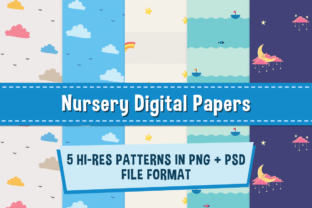
A well-curated set—such as one featuring 5 digital papers—delivers immediate utility without overwhelm. For example, a thoughtful 5-paper collection might include: (1) a soft sky-blue gingham for gentle structure, (2) a muted sage leaf repeat for nature-based themes, (3) a delicate cloud-and-star pattern in ivory and pale yellow, (4) a minimalist dot grid in warm taupe for writing practice sheets, and (5) a subtle linen texture in off-white for elegant labels or certificates. Each paper is intentionally designed to complement—not compete with—text, photos, or hand-drawn elements. This balance is critical: too much detail overwhelms young eyes; too little feels sterile. Nursery Digital Papers strike that middle ground by default.
The inclusion of PNG and PSD files significantly expands usability. PNGs provide crisp, transparent-background versions ideal for layering over photos or combining with other graphics in Canva, Google Slides, or PowerPoint—no design software required. PSD files, meanwhile, empower users with Adobe Photoshop or compatible editors to adjust colors, tweak contrast, isolate pattern elements, or resize seamlessly using smart objects. That dual-format access means a parent using free tools can get started immediately, while a professional designer retains full creative control. It also future-proofs your investment: as your needs evolve—from printing laminated cards today to building an interactive PDF lesson tomorrow—the same file set adapts.
Practical application starts with intentionality. Before downloading or purchasing any Nursery Digital Papers, consider your most frequent use cases. Are you primarily printing? Then prioritize 300 DPI resolution and CMYK-friendly color profiles. Creating digital resources for tablets or learning apps? Ensure PNGs are optimized for screen clarity (72–150 DPI, RGB). Building branded materials? Look for coordinated palettes and consistent scaling across the set—so your “All About Me” booklet and alphabet posters feel like part of the same system. Also check licensing: reputable Nursery Digital Papers come with clear commercial-use permissions (especially important for sellers), personal-use clarity, and no attribution requirements—removing legal guesswork from your workflow.
Different users leverage Nursery Digital Papers in distinct, equally valid ways. A Montessori guide may use the linen-texture paper as a subtle base for sandpaper letter overlays, valuing its tactile suggestion and visual calm. A speech-language pathologist might layer a cloud-pattern background behind articulation cards—softening visual stimulation while maintaining focus on mouth movements. A busy parent preparing for a toddler’s first birthday could combine the starry-night paper with editable text to generate instant place cards, cupcake toppers, and a photo backdrop—all in under 20 minutes. The power lies not in complexity, but in consistency and context-aware design.
Outcomes are tangible and time-sensitive. Teachers report cutting prep time by 40–60% when using pre-aligned, educationally tuned digital papers versus starting from blank canvases. Small-business owners note higher perceived value in their printable bundles—customers recognize cohesive, polished design as a sign of expertise and care. Even casual users notice reduced frustration: no more hunting for “just right” colors, worrying about pixelation, or accidentally violating terms of use. With Nursery Digital Papers, the design work is done thoughtfully once—so you can focus on what matters most: supporting early learning, nurturing curiosity, and creating meaningful moments.
To get the most from your set, start small. Pick one paper and use it across three related items—a welcome sign, a daily schedule strip, and a reward sticker sheet. Notice how repetition builds visual familiarity for children. Then gradually introduce a second paper for contrast—say, the gingham for structural elements and the leaf pattern for nature-themed centers. Avoid overmixing; young children benefit from predictable visual cues. And remember: these papers are enablers, not replacements. Their greatest strength emerges when paired with your knowledge, your voice, and your understanding of the children you serve.
In a landscape crowded with flashy digital tools and overwhelming resource libraries, Nursery Digital Papers stand out by doing one thing exceptionally well: providing quiet, capable, developmentally grounded design foundations. They don’t promise AI-generated lesson plans or automated grading—they deliver what educators and creators actually reach for daily: beautiful, usable, ethically sourced, technically sound starting points. When your goal is clarity, calm, and consistency for early learners, choosing the right digital paper isn’t a minor detail—it’s your first intentional teaching decision.