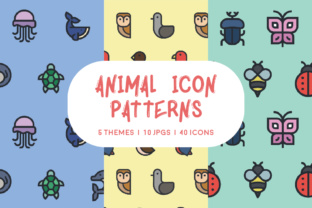
Animal Icon Patterns: Vibrant, Flexible Learning Tools for Early Years Education
Animal Icon Patterns are thoughtfully designed visual resources that bring playful learning to life in nurseries, preschools, and primary classrooms. More than just cute illustrations, these patterns combine educational intention with creative flexibility — offering educators, designers, and curriculum developers a cohesive, high-quality set of animal-themed icons that support visual literacy, thematic planning, and inclusive classroom environments.
Why Animal Icon Patterns Stand Out in Early Years Settings
In early childhood education, visuals aren’t decorative extras — they’re essential scaffolds for communication, memory, routine-building, and language development. Animal Icon Patterns meet this need with purpose-built design principles: clear silhouettes, consistent proportions, intuitive expressions, and intentional spacing. Each icon is crafted to be instantly recognisable by young children, even before reading fluency develops.
Unlike generic clipart or inconsistent free downloads, Animal Icon Patterns deliver professional-grade cohesion. Every icon shares the same visual grammar — whether used in a morning routine chart, a sensory bin label, or a classroom job board. That consistency reduces cognitive load and reinforces understanding across diverse learners, including those with speech, language, or neurodiverse needs.
Five Thematic Collections Designed for Real Classroom Use
The core offering includes five distinct themes — each curated to reflect common early years topics while supporting cross-curricular connections. For every theme, you receive:
- Two fully editable A3-sized JPEG files (one full-colour version, one clean outline version), ideal for printing posters, display boards, or laminated reference charts;
- 40 high-resolution PNG files (transparent background, 300dpi), ready for digital whiteboards, interactive apps, or custom resource creation;
- Illustrator-compatible source files (AI format), allowing teachers or school designers to adjust colours, scale, or layer elements without quality loss.
Theme 1: Forest Friends
Includes foxes, owls, hedgehogs, squirrels, badgers, deer, frogs, rabbits, moths, and more — all drawn with gentle, approachable features. Perfect for woodland-themed units, seasonal science lessons, or calming corner signage. The outline version supports fine motor tracing activities; the full-colour set brings nature studies to life on walls and story sacks.
Theme 2: Ocean Explorers
Features dolphins, octopuses, seahorses, turtles, starfish, crabs, clownfish, whales, jellyfish, and coral motifs. Used widely in water-cycle introductions, marine biology tasters, or sensory play labels. Educators report improved engagement during “under-the-sea” transitions and circle-time discussions — especially when paired with tactile props.
Theme 3: Farmyard Learners
A classic but refreshed collection: chickens, pigs, sheep, cows, ducks, goats, horses, bees, butterflies, and scarecrows. Supports phonics (e.g., “b” for bee, “d” for duck), counting exercises, and role-play area organisation. Teachers often use the outline icons for collaborative drawing sessions or as stencils for clay work.
Theme 4: Safari Discoverers
Brings lions, elephants, giraffes, zebras, meerkats, flamingos, chameleons, rhinos, warthogs, and baobab-inspired frames. Ideal for geography links, cultural awareness starters, or large-motor movement games (“jump like a kangaroo”, “stretch like a giraffe”). The bold colour palette holds attention during whole-group instruction.
Theme 5: Garden Companions
Centred on insects, birds, and small garden dwellers: ladybirds, snails, bees, robins, worms, caterpillars, dragonflies, daisies, mushrooms, and watering cans. Frequently integrated into outdoor learning logs, plant-life cycles, and wellbeing-focused breathing cards (“breathe in like a butterfly, breathe out like a snail”).
Who Benefits — and How
Educators and SENCOs use Animal Icon Patterns to build visual timetables, emotion charts, and step-by-step instructions — reducing verbal overload and increasing independence. One nursery lead shared how switching from text-based routines to themed icon sequences cut transition time by nearly 40%.
Curriculum Designers and Local Authorities appreciate the scalability: the same icon set works across age bands (EYFS through Year 2), supports bilingual settings (icons transcend language barriers), and aligns with EYFS Development Matters and UK curriculum themes.
Parents and Home Educators find them invaluable for creating calm, structured home learning spaces — especially during periods of change or uncertainty. The editable Illustrator files mean families can personalise icons with names, photos, or home languages.
Designers and EdTech Developers value the technical readiness: consistent sizing, vector scalability, and transparent PNGs make integration into apps, websites, and printed materials seamless — no reworking or resizing needed.
Practical Strengths — and Honest Considerations
Strengths:
- Time-saving: No more hunting for matching icons across ten different websites — everything is unified, labelled, and organised by theme.
- Accessibility-forward: High-contrast outlines, uncluttered forms, and expressive yet neutral faces support diverse visual processing needs.
- Adaptability: Works equally well on paper, interactive screens, fabric banners, or vinyl stickers — thanks to layered, editable source files.
- Curriculum-aligned: Icons map naturally to real-world animals, habitats, and science concepts — not just abstract symbols.
Considerations:
- These are not animated or audio-enabled — they’re static visual tools designed for hands-on, human-led learning. Pair them with storytelling, movement, or realia for best impact.
- While highly customisable in Illustrator, basic editing knowledge helps unlock full potential — though many users begin simply by resizing and printing the JPEGs.
- They focus on common, familiar animals rather than rare or region-specific species — prioritising recognition and relevance over taxonomic breadth.
Real-World Applications You Can Try Tomorrow
- Morning Routine Board: Print the Forest Friends outline A3 sheet, laminate it, and attach Velcro-backed icons for children to move as they complete tasks (“I’ve hung up my coat”, “I’ve chosen my learning partner”).
- Sensory Bin Labels: Use Ocean Explorers PNGs to label bins containing shells, blue rice, toy crabs, and textured seaweed — reinforcing vocabulary and classification skills.
- Emotion Matching Game: Print Garden Companions icons in two sizes — large for floor sorting, small for hand-held matching — and pair with simple emotion words or faces.
- Outdoor Learning Trail: Print Safari Discoverers icons on weatherproof card, hide them around the playground, and invite children to find and name each animal — adding movement to vocabulary practice.
- Parent Workshop Handout: Share the Farmyard Learners AI file with families and guide them to add their child’s photo beside the “chicken” or “sheep” icon to co-create a “My First Farm” booklet.
Evaluating Fit for Your Needs
Ask yourself:
- Do I regularly create visual aids — and spend hours sourcing or redrawing mismatched icons?
- Do my learners benefit from consistent, predictable imagery — especially during transitions or new routines?
- Am I looking for resources that grow with my class — usable in September and revisited meaningfully in July?
- Do I value having control — to change a colour, add a label, or adapt size — without losing quality?
If you answered “yes” to two or more, Animal Icon Patterns offer tangible, classroom-tested value. They won’t replace teacher expertise — but they do remove friction, deepen visual coherence, and quietly empower both educators and children to focus on what matters most: connection, curiosity, and joyful learning.
Final Thought: Patterns That Grow With Learning
At its heart, Animal Icon Patterns is about respect — for children’s developing perception, for educators’ time, and for the quiet power of well-designed visuals. It’s not flashy software or AI-generated novelty. It’s a grounded, practical toolkit — rooted in early years pedagogy, refined through real nursery feedback, and built to last across terms, topics, and teaching teams. Whether you’re setting up your first classroom or refreshing a decade-old resource library, these icons don’t shout. But they do speak clearly — and children listen.