Dog Patterns: A Practical Evaluation for Designers and Crafters
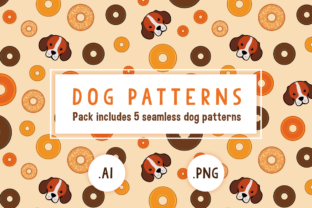
Dog Patterns is a curated collection of five original, scalable dog-themed pattern designs—each delivered as high-resolution PNG files and a fully editable Adobe Illustrator (AI) source file. These patterns feature clean vector-based motifs of dogs in varied poses and stylizations, optimized for repeat tiling without visible seams. They are intended for designers, illustrators, educators, and hobbyists who need ready-to-use, customizable animal motifs for surface design, textile work, branding elements, or educational materials.
Why Consider Dog Patterns?
Designers often face recurring challenges when sourcing thematic assets: finding patterns that balance visual appeal with technical flexibility, avoiding copyright complications, and ensuring consistency across projects. Dog Patterns addresses several of these needs at once. Its inclusion of both raster (PNG) and vector (AI) formats supports immediate application—such as placing a pattern into a mockup or presentation—as well as long-term adaptability for resizing, recoloring, or editing individual elements.
Interest in Dog Patterns typically arises from specific practical contexts: creating pet-related product packaging, designing classroom visuals for early childhood education, developing branded merchandise for veterinary clinics or rescue organizations, or prototyping fabric prints for apparel or home goods. The focus on canines—rather than generic animals—offers thematic precision where relevance matters.
Key Benefits and Realistic Tradeoffs
The primary benefit lies in efficiency and control. With the Illustrator file, users can adjust stroke weights, isolate individual dog silhouettes, change colors globally or per motif, or modify spacing between repeats—all without degrading quality. The PNGs provide plug-and-play compatibility across platforms that don’t support AI files, including web builders, basic graphic editors, and print-on-demand templates.
However, there are tradeoffs to acknowledge. Because the set includes only five distinct patterns, it does not offer stylistic variety across illustration genres (e.g., watercolor, line art, photorealistic). All patterns share a consistent, simplified vector aesthetic—clean and modern, but intentionally restrained in texture and nuance. Users seeking highly detailed, hand-drawn, or culturally specific interpretations (e.g., breed-specific accuracy or regional folklore motifs) may find the scope limited.
Another consideration is scalability in use. While the vector format ensures crisp output at any size, the patterns are designed for seamless tiling—not for standalone icon use. Attempting to extract single dogs for logos or app icons may require additional cleanup, as motifs are embedded within a repeating grid structure rather than provided as isolated symbols.
Situations Where Dog Patterns Is a Strong Fit
Dog Patterns works well when your goal is functional, repeatable surface decoration with canine themes—and when you value editability over stylistic breadth. It’s especially suitable for:
- Small-business branding: A local dog-walking service or boutique pet store needing cohesive background patterns for business cards, social media banners, or packaging inserts.
- Educational resource creation: Teachers designing printable worksheets, flashcards, or classroom borders where consistent, non-distracting dog motifs reinforce learning themes.
- Prototyping textile or stationery concepts: Designers validating layout ideas before commissioning custom illustrations or committing to full print runs.
- Time-constrained projects: When deadlines preclude commissioning bespoke artwork or sifting through large stock libraries with inconsistent licensing terms.
In each case, the combination of ready-made usability and vector flexibility reduces friction without sacrificing professional output quality.
When Alternatives May Be More Appropriate
Dog Patterns is not a universal solution. Consider alternatives if your project requires:
- Highly specialized representation: For example, accurate depictions of rare breeds, historical dog roles (e.g., herding or sledding), or anatomically precise illustrations for veterinary training materials. In those cases, commissioning an illustrator or licensing scientific or archival imagery may be necessary.
- Broader thematic coverage: If your work spans multiple animal types—or includes dogs alongside cats, birds, or wildlife—a generalized animal pattern pack may offer better long-term utility than a dog-only set.
- Dynamic or interactive use: For web animations, SVG-based responsive graphics, or motion design, the static nature of these PNG/AI files means additional development work would be needed to achieve interactivity or adaptive behavior.
- Licensing for commercial redistribution: While Dog Patterns permits standard commercial use (e.g., selling products featuring the patterns), it does not grant rights to resell or sublicense the patterns themselves. Platforms requiring royalty-free redistribution rights—like certain digital asset marketplaces—would require different licensing arrangements.
Making an Informed Decision
To determine whether Dog Patterns aligns with your goals, begin by clarifying two things: your intended use case and your capacity for customization. Ask yourself:
- Do I need patterns that tile seamlessly across surfaces—or am I looking for individual dog icons or scenes?
- Will I benefit from editing color, scale, or composition myself—or do I prefer fully finished, “as-is” assets?
- Is thematic specificity (i.e., dogs only) an advantage—or would broader animal variety better serve my audience or brand?
- What tools will I use? If you regularly work in Illustrator or compatible vector software, the AI file adds significant value. If your workflow relies entirely on raster editors or no-design tools (e.g., Canva), the PNGs alone may suffice—but you’ll lose modifiability.
Also consider longevity. Because the patterns are delivered as open-format files—not locked plugins or proprietary software—you retain full ownership and control. There are no subscriptions, usage caps, or platform dependencies. That independence supports long-term asset management, especially for teams maintaining consistent visual systems across multiple projects.
Final Considerations Before Use
Before integrating Dog Patterns into a project, verify technical compatibility. The PNGs are transparent-background, RGB-mode files—ideal for digital use but requiring conversion to CMYK and appropriate resolution checks for professional print. The Illustrator file uses standard vector objects and fonts (if any text is present); no plugins or extensions are required, but older versions of Illustrator may need to expand appearance attributes manually.
Lastly, assess alignment with audience expectations. While the patterns are friendly and accessible, their minimalist style may feel too generic for audiences valuing artisanal, nostalgic, or highly personalized aesthetics. Conversely, that same simplicity makes them adaptable across age groups and contexts—from pediatric clinic walls to modern pet-tech branding.
Dog Patterns offers a focused, technically sound solution for a narrow but common design need. Its strength lies not in breadth or novelty, but in reliability, clarity of purpose, and respect for the user’s time and creative agency. When your priority is getting usable, editable, dog-themed patterns into production quickly—and when that specificity serves your goals—it stands as a practical, low-risk option worth evaluating alongside broader alternatives.