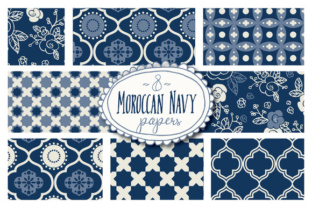
Moroccan Navy Patterns: Strategic Design Assets for Purpose-Driven Creatives
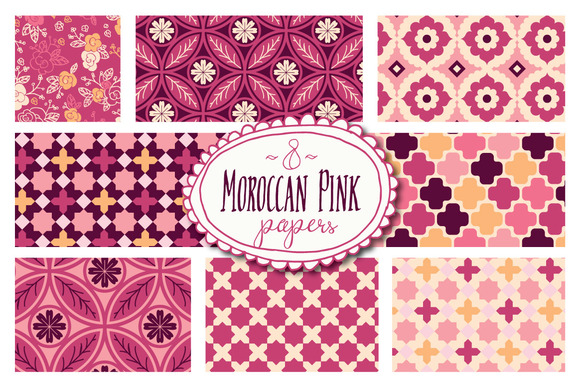
Moroccan Navy Patterns is more than a collection of decorative papers—it’s a precision-crafted design system built for intentionality. At its core, it delivers 16 high-resolution JPEGs (12×12 inches, 300 dpi), eight color swatches in multiple formats, and fully editable vector assets (AI and EPS) designed for Adobe Illustrator users with foundational skills. What sets it apart isn’t just aesthetic fidelity to Moroccan tilework and textile motifs—it’s the deliberate flexibility embedded in every file: seamless tiles for infinite tiling in Photoshop, tight and loose pattern variants for scale-sensitive layouts, and vector-based patterns that allow color swaps, resizing, and structural adaptation without quality loss.
Why This Matters Strategically—Not Just Aesthetically
For creators who manage brand consistency across touchpoints—think stationery suites for boutique weddings, cohesive social media templates for small businesses, or tactile packaging for artisanal goods—Moroccan Navy Patterns offers predictable visual cohesion without creative fatigue. Unlike one-off graphics, this set functions as a modular language: each paper shares underlying geometry, rhythm, and tonal restraint (deep navy anchors the palette, allowing gold, cream, terracotta, or sage to harmonize without clashing). That consistency reduces decision latency—the mental cost of choosing colors or scales mid-project—and supports long-term brand recognition. When your invitation suite, email header, and product label all draw from the same rhythmic base, customers subconsciously register continuity—even if they never name the pattern.
When to Use Moroccan Navy Patterns—And When to Pause
Moroccan Navy Patterns excels in contexts where visual authority and cultural resonance matter—but only when aligned with clear goals. Use it when:
- You’re designing for audiences that value craftsmanship, heritage, or Mediterranean warmth—e.g., luxury travel brands, wellness studios, or handmade goods retailers.
- You need rapid iteration across formats: a single seamless tile can generate a full background for a Canva presentation slide, then scale cleanly to a 24×36-inch wall poster in Illustrator.
- You’re building reusable templates—say, a quarterly newsletter series—where swapping a single color in the vector file updates every instance of the pattern across documents.
Avoid relying on Moroccan Navy Patterns as a default aesthetic crutch. If your brand voice is minimalist, industrial, or tech-forward, forcing ornate geometry into that framework risks dissonance—not distinction. Before importing a paper into your layout, ask: does this reinforce the message, or distract from it? Does the density of the tight pattern support legibility at small sizes (e.g., business card text overlays), or would the looser variant provide necessary breathing room?
Practical Integration: From File to Outcome
Start with purpose—not prettiness. Identify the primary function of your project: Is it to evoke calm (choose lower-contrast swatches like navy + oat)? To signal celebration (introduce metallic gold via the vector file)? To communicate authenticity (leverage the hand-drawn irregularity preserved in the JPEGs)? Then match format to workflow:
- For quick digital mockups: Use the seamless Photoshop tiles. Drag one into a new document, apply “Pattern Overlay” or “Fill Layer,” and adjust scale non-destructively.
- For print-ready stationery: Import the 12×12 JPEGs directly into InDesign or Affinity Publisher. Their 300dpi resolution ensures crisp output—even at bleed edges.
- For scalable branding elements: Open the AI file in Illustrator. Ungroup layers to isolate motifs, recolor using Global Swatches, or resize individual elements while preserving proportions. (Note: basic Illustrator fluency is required—this isn’t drag-and-drop, but it’s also not coding.)
Don’t overlook the swatches. The eight JPEG swatches aren’t just color previews—they’re calibrated for accurate soft-proofing in Photoshop or GIMP. Load the PAT file once, and you’ll have instant access to the full palette across projects, eliminating guesswork when matching a navy background to a border element.
Risks of Unintentional Use—and How to Mitigate Them
The biggest risk with Moroccan Navy Patterns isn’t technical limitation—it’s context collapse. Using the same intricate motif for a legal disclaimer PDF and a playful baby shower invitation dilutes both messages. Ornamentation carries weight: dense geometry signals richness and tradition; simplified repeats suggest modern reinterpretation. Without aligning pattern density and color intensity to audience expectations and medium constraints, you risk visual overload (e.g., tight patterns competing with body text) or unintended formality (e.g., navy-and-gold tiles undermining a casual brand voice).
Mitigate this by establishing guardrails early. Define two rules before opening the folder:
- One primary use case per project: If designing wedding stationery, decide whether Moroccan Navy Patterns anchors the invitation (large loose paper), frames the RSVP card (tight pattern), or accents the envelope liner (vector-recolored motif). Don’t use all three simultaneously without hierarchy.
- Contrast discipline: Pair busy patterns with ample negative space or ultra-simple typography. A serif font with high x-height and generous letter-spacing will hold its own against complex geometry far better than a delicate script.
Long-Term Value: Beyond the First Project
Moroccan Navy Patterns pays dividends over time—not because it’s trendy, but because it’s engineered for reuse. The vector files let you future-proof designs: change a brand’s accent color from gold to emerald without repurchasing assets; adapt a tile’s scale for a new product line’s packaging dimensions; or extract a single motif to become a custom icon set. For educators creating culturally grounded lesson materials, the consistent geometry supports visual literacy discussions about symmetry and tessellation. For freelancers pitching to hospitality clients, having a ready-made, culturally resonant pattern library shortens discovery phases and strengthens proposals with tangible examples.
This isn’t about filling space. It’s about selecting a visual grammar that serves your objective—whether that’s guiding the eye, reinforcing trust, evoking place, or simply reducing production friction. Moroccan Navy Patterns gives you the vocabulary. Your strategy determines how fluently you speak it.
Final Consideration: Skill Alignment Is Non-Negotiable
The editable vector files are powerful—but only if you have baseline Illustrator competence. If you don’t regularly use Layers, Appearance panels, or Global Swatches, start small: open the AI file, isolate one motif, and practice recoloring it using Edit > Edit Colors > Recolor Artwork. Don’t attempt full-scale edits on deadline day. Similarly, the seamless Photoshop tiles assume familiarity with blending modes and layer masks. Test them in a low-stakes project first—like a personal blog header—before deploying them in client deliverables.
Moroccan Navy Patterns rewards thoughtful preparation. It won’t replace strategic thinking—but in the hands of someone who plans before pixel-pushing, it becomes a quiet force multiplier: elevating execution, reinforcing intent, and turning decorative choices into deliberate decisions.